Half Sized Blog Element (Single Author Style)
Half Sized Blog Element (Multi Author Style)

When AI Cannot Replace the Human Touch: What Yuna’s Words Remind Us About HAIL
A recent Malay Mail article on Yuna’s achievement as the first Malaysian artist to surpass one billion Spotify streams carried something more meaningful than just a milestone.
Yuna becomes first Malaysian artist to hit one billion Spotify streams, says AI can’t replace human touch
It also captured her view that AI, however advanced, cannot replace the human touch in music.That stayed with me.Because it is easy, in this moment, to be impressed by what AI can produce.
A song.
A paragraph.
A lesson plan.
A voice.
An image.
Even something that looks and sounds almost human.But almost human is not the same as human.
Music reminds us of this. A song is not only melody, arrangement, or lyrics. It carries memory, struggle, timing, culture, silence, instinct, and sometimes the small imperfections that make it feel alive. The same is true in education.Learning is not only the finished answer.It is the thinking before the answer.
The hesitation.
The discussion.
The mistake.
The attempt to explain something in your own words.
The quiet moment when a student finally understands.These things matter, even if they are not always measurable.Yuna’s comment is a timely reminder that technology may support human creativity, but it should not flatten it. In the classroom, the same principle applies. AI can help. It can suggest, summarise, translate, organise, and offer possibilities. But it should not become the place where students surrender their own thinking too quickly.This is where frameworks such as HAIL become useful, not as a campaign against AI, but as a reminder of proportion.
Use the tool.
But do not lose the person.
For students, that means learning to pause before outsourcing a thought. For teachers, it means guiding young people to see AI as support, not as a substitute for effort, judgement, or voice.Perhaps the real challenge is not whether AI can create something impressive.It can.The deeper question is whether we are still helping students develop the human qualities that make their work meaningful in the first place.
Curiosity.
Discipline.
Original thought.
Responsibility.
Taste.
Care.
A point of view.
Yuna’s milestone is worth celebrating because it was not built by automation.
It was built through years of voice, craft, identity, and persistence.That is the part we should not forget.
In music, in learning, and in life, the human touch is not a decorative extra.
It is the thing that gives the work its soul.
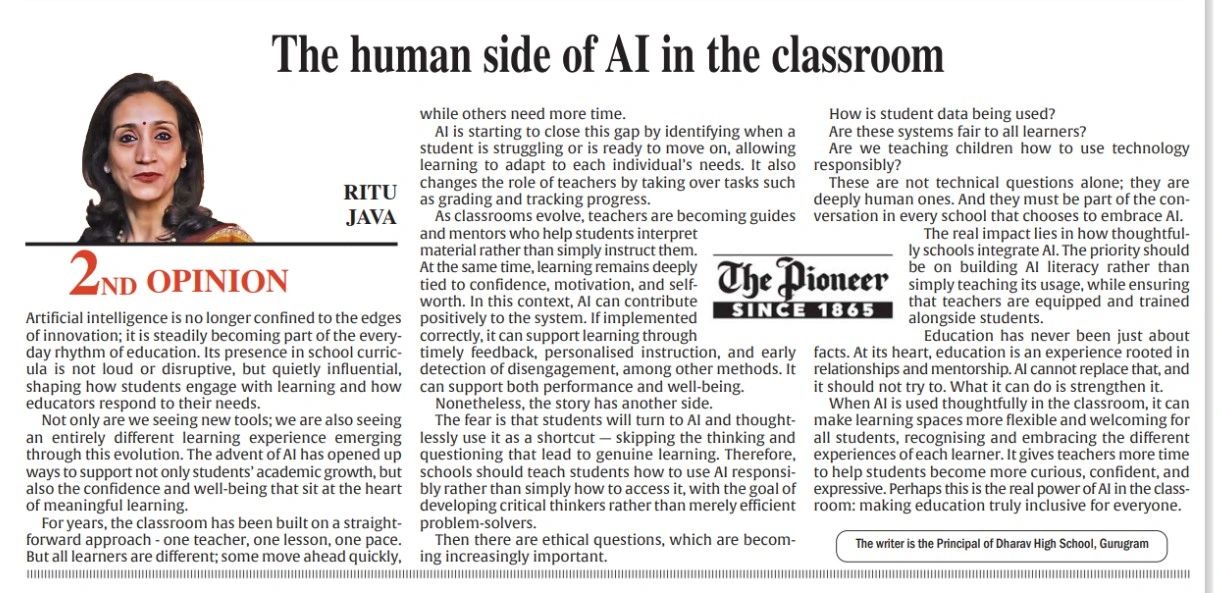
The Human Side Of AI In The Classroom
and Why HAIL Matters A recent opinion piece in The Pioneer titled “The human side of AI in the classroom” raises a timely and important point: AI is no longer sitting at the edges of education. It is already shaping how students learn, how teachers respond, and how classrooms adapt. The article rightly recognises the […]
When AI Cannot Replace the Human Touch: What Yuna’s Words Remind Us About HAIL
/0 Comments/in Uncategorized /by scottjwong@gmail.comA recent Malay Mail article on Yuna’s achievement as the first Malaysian artist to surpass one billion Spotify streams carried something more meaningful than just a milestone.
Yuna becomes first Malaysian artist to hit one billion Spotify streams, says AI can’t replace human touch
It also captured her view that AI, however advanced, cannot replace the human touch in music.That stayed with me.Because it is easy, in this moment, to be impressed by what AI can produce.
A song.
A paragraph.
A lesson plan.
A voice.
An image.
Even something that looks and sounds almost human.But almost human is not the same as human.
Music reminds us of this. A song is not only melody, arrangement, or lyrics. It carries memory, struggle, timing, culture, silence, instinct, and sometimes the small imperfections that make it feel alive. The same is true in education.Learning is not only the finished answer.It is the thinking before the answer.
The hesitation.
The discussion.
The mistake.
The attempt to explain something in your own words.
The quiet moment when a student finally understands.These things matter, even if they are not always measurable.Yuna’s comment is a timely reminder that technology may support human creativity, but it should not flatten it. In the classroom, the same principle applies. AI can help. It can suggest, summarise, translate, organise, and offer possibilities. But it should not become the place where students surrender their own thinking too quickly.This is where frameworks such as HAIL become useful, not as a campaign against AI, but as a reminder of proportion.
Use the tool.
But do not lose the person.
For students, that means learning to pause before outsourcing a thought. For teachers, it means guiding young people to see AI as support, not as a substitute for effort, judgement, or voice.Perhaps the real challenge is not whether AI can create something impressive.It can.The deeper question is whether we are still helping students develop the human qualities that make their work meaningful in the first place.
Curiosity.
Discipline.
Original thought.
Responsibility.
Taste.
Care.
A point of view.
Yuna’s milestone is worth celebrating because it was not built by automation.
It was built through years of voice, craft, identity, and persistence.That is the part we should not forget.
In music, in learning, and in life, the human touch is not a decorative extra.
It is the thing that gives the work its soul.
The Human Side Of AI In The Classroom
/0 Comments/in Uncategorized /by scottjwong@gmail.comand Why HAIL Matters A recent opinion piece in The Pioneer titled “The human side of AI in the classroom” raises a timely and important point: AI is no longer sitting at the edges of education. It is already shaping how students learn, how teachers respond, and how classrooms adapt. The article rightly recognises the […]