Entries by scottjwong@gmail.com

OECD Digital Education Outlook 2026: Why AI Must Remain Learning-First

"72% of lower secondary teachers believe AI can harm academic integrity by letting students pass off work as their own"

The OECD Digital Education Outlook 2026 reminds us that generative AI can support learning, but only when guided by sound teaching principles.

Without that guidance, AI may improve the appearance of student performance without deepening actual learning.
This distinction matters.

A student’s work may become more polished, fluent, and efficient, but we still need to ask whether the student has truly thought, questioned, struggled, verified, and understood the work well enough to explain it in their own words.

This is the danger of the illusion of competence: the product improves, but the learner may not.For Generation Alpha, this is especially important. They will grow up surrounded by instant answers and intelligent tools. But speed is not depth. Fluency is not wisdom. Completion is not formation.

The deeper question is not whether students can use AI. They can, and they will.The real question is what kind of learners they are becoming while using it.

Education must remain learning-first, teacher-guided, and human-centred. AI should support the learning process, not replace the struggle, reflection, discussion, and judgement through which real understanding is formed.

Because education is not merely about producing better answers.

It is about forming better thinkers.

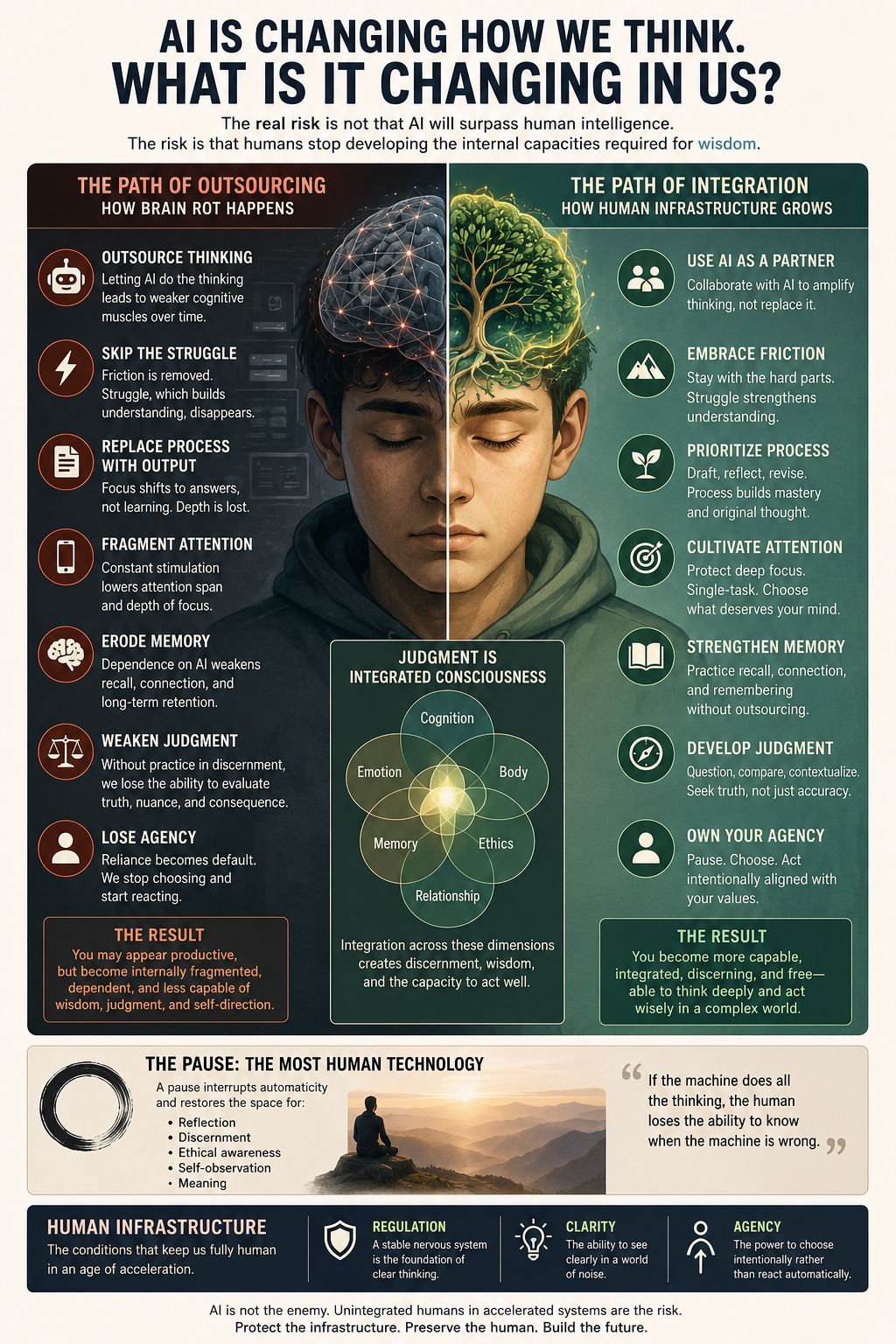
AI Is Changing How We Think. What Is It Changing In Us?

Inspired by Orli Shull’s powerful reflection on “human infrastructure” in the age of AI.

AI is not the enemy.
But there is a risk we should be honest enough to name.

If we allow AI to do too much of our thinking too early, we may slowly weaken the very capacities that make us human: attention, memory, judgement, discernment, agency, and wisdom.

The danger is subtle.
The work may look better.
The answers may sound sharper.
The output may appear more polished.

But beneath the surface, are we still thinking deeply?
Are we still struggling through the difficult parts?
Are we still learning to question, compare, remember, reflect, and decide?
This matters deeply for education, especially for Generation Alpha.

They will grow up surrounded by instant intelligence. Answers will be available before questions are fully formed. Explanations will arrive before confusion has had time to do its work.

But confusion is not always a problem to remove.
Sometimes, it is the beginning of understanding.
The struggle matters.
The pause matters.
The first attempt matters.
The mistake matters.
The moment a student says, “I am not sure yet,” matters.

These are not delays in learning. They are part of how the mind is formed.

AI can be a powerful partner. It can support thinking, widen perspectives, help refine ideas, and make learning more accessible.

But it should not replace the formation of the learner.

If the machine does all the thinking, the human may still produce an answer. But will they know when the answer is wrong?
Will they know what is missing?
Will they know how to act with wisdom?

This is why we need to protect our human infrastructure.
Attention.
Memory.
Ethics.
Reflection.
Judgement.
Empathy.
Agency.
These are not soft skills.
They are survival skills for an AI-shaped world.
The future will not only depend on how intelligent AI becomes.

It will depend on how deeply human we remain while using it.

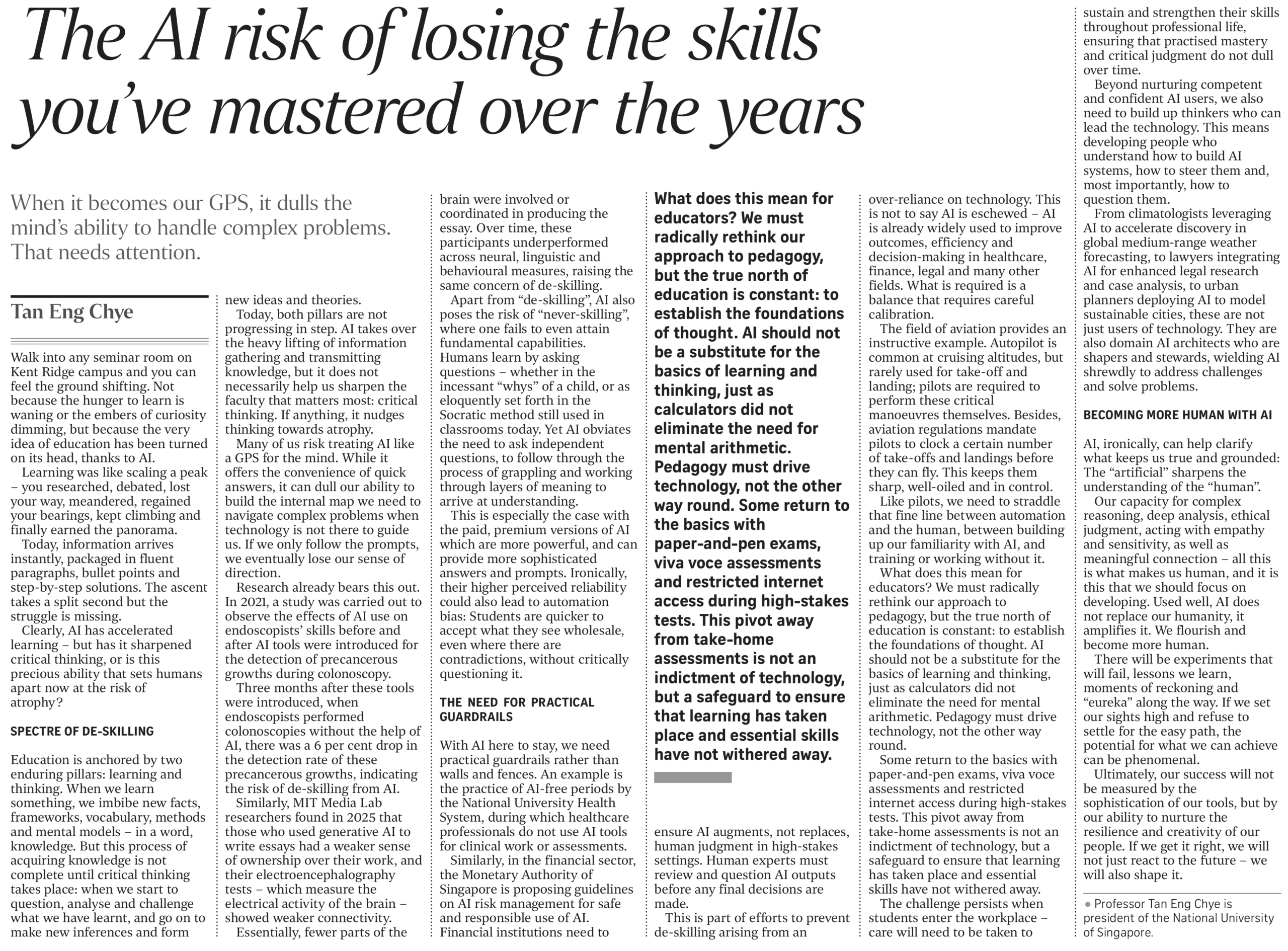
The AI Risk of losing the skills you’ve mastered over the years

AI is changing how we learn, work, write, think, and make decisions.That is not necessarily a bad thing. But Professor Tan Eng Chye’s recent opinion piece in The Straits Times raises a concern we should take seriously: when AI becomes too convenient, we may slowly lose the very skills we once worked hard to master.

He describes AI as a kind of “GPS for the mind”, useful for quick direction, but dangerous if it weakens our ability to build our own internal map.

This matters deeply in education.Learning is not just about reaching the answer. It is about the struggle that forms understanding. The questioning. The confusion. The revision. The slow process of connecting ideas until something becomes truly our own.

AI can help students produce polished work. But polished work is not always proof of deep thinking.This is the danger of the illusion of competence.

A student may appear capable because the output looks good. But beneath the surface, have they learnt to reason, question, verify, explain, and make responsible judgements?The article also warns about “de-skilling” and “never-skilling”.

De-skilling is when we lose abilities we once had. Never-skilling is when young learners never develop those abilities properly in the first place because AI answers too quickly.

For Generation Alpha, this is especially important.They will not lack access to tools. They will not lack speed. They will not lack information.What they need is the wisdom to use these tools without surrendering their own thinking.

This does not mean we should reject AI. That would be too simple, and unrealistic. AI is here, and it can support learning powerfully when used well.

But the order matters.

Students must still learn to think before they outsource. They must learn to ask before they accept. They must learn to struggle before they generate.

AI should support the mind, not replace its formation.

That is the deeper responsibility before us.

Not to raise students who can simply produce better answers.

But to form young people who can think with clarity, act with responsibility, and use technology with wisdom.

Human first.
AI as a tool, second.

AI May Be Eroding Critical Thinking Skills

A recent TIME article on ChatGPT and learning gave me pause.
(and this includes other AI tools such as Gemini, Grok, Claude, Deepseek etc)

ChatGPT May Be Eroding Critical Thinking Skills

It discussed an MIT Media Lab study where participants wrote essays using ChatGPT, Google Search, or no tool. The findings are still preliminary, so we should not overstate them. But the concern is worth taking seriously.
The group that used ChatGPT showed the lowest brain engagement.
For me, this is not a reason to reject AI.
It is a reason to ask whether we are introducing AI in the right order.

This is where HAIL matters.
Human first.
Tool second.
Think First, AI Second.

The danger is not that Generation Alpha will use AI. They will. It will be part of their world.
The danger is that they may begin with AI before they have learned to sit with a question, form their own thoughts, make mistakes, explain their reasoning, or struggle through uncertainty.
And that struggle matters.It is where judgement is formed.

It is where curiosity grows.
It is where confidence becomes real.
It is where wisdom begins.

AI can give students polished answers. But polished answers do not always mean deep understanding.
Fluency is not wisdom.

Speed is not depth.

A completed task is not always a formed mind.

If AI becomes the get-go instead of the go-to, we risk raising a generation that can produce impressive work, but may not always know how they got there.

HAIL is not about holding students back from technology.It is about helping them grow into the kind of human beings who can use technology with thought, care, responsibility, and discernment.

Generation Alpha will not lack tools.
What they need is the wisdom to use them well.

Better Output Is Not Always Better Learning

Dr. Genevieve Bosma Martínez recently shared an important reflection on AI in education, and it touches on a tension that many of us need to sit with more honestly.
AI can help students produce better work.
That much is clear.

A piece of writing may become more polished. An answer may become more complete. A project may look more refined. In many cases, AI can help students move faster, organise their thoughts better, and improve the quality of what they submit.
But this raises a deeper question.
Does better output always mean deeper learning?

Not necessarily.

This is where the conversation becomes important.In education, we cannot only look at the final answer. We have to look at what happens inside the learner before that answer appears. Did the student understand the problem? Did they wrestle with the question? Did they compare ideas, test assumptions, make mistakes, and try again? Did they learn how to explain their reasoning?

Or did AI simply help them arrive at a better-looking answer before the learning had time to take root?

This is not an argument against AI.
AI has a place in education. It can support teachers. It can help students refine their ideas. It can open access to explanations, examples, feedback, and creative possibilities that were not available in the same way before.

But AI must enter the learning process with care.The concern is not that students are using AI.
The concern is that they may begin to depend on AI before they have developed the human capacities that education is meant to strengthen.

Critical thinking.
Problem solving.
Judgement.
Reflection.
Responsibility.

The ability to sit with uncertainty.

The confidence to think before asking a machine to think for them.These are not small things. They are the foundations of learning itself.If students use AI too early in the process, there is a risk that the visible work improves while the invisible learning weakens. The assignment may look better, but the student may not become more capable.

The answer may be correct, but the reasoning may remain underdeveloped.
That should concern us.

Because the purpose of education is not simply to produce neat answers. It is to form thoughtful human beings.

This is why human-centred AI learning matters.

It reminds us that technology should support the learner, not replace the learner’s thinking. AI should help students extend their understanding, not bypass the struggle that helps understanding grow.

There is a kind of learning that only happens through effort.
Through confusion.
Through discussion.
Through trying to explain something in your own words and realising you do not fully understand it yet.
Through making a mistake and learning why it was wrong.
Through listening to another person’s point of view.
Through slowly building the confidence to say, “This is what I think, and this is why.”

AI can assist this process.
But it should not remove it.

The future of education cannot be measured only by speed, efficiency, or polished outputs. If we are not careful, we may teach students how to generate impressive work without helping them become independent thinkers.
And that would be a poor bargain.In an age where AI can generate almost anything, the role of education becomes even more human, not less.

We must teach students how to question.
How to judge.
How to care.
How to take responsibility for what they create.How to use powerful tools without surrendering their own agency.
AI should be a support tool.
Not the starting point.
Not the substitute.
Not the authority.

The human mind must remain at the centre of learning.
That is the work ahead of us.

Original posting:
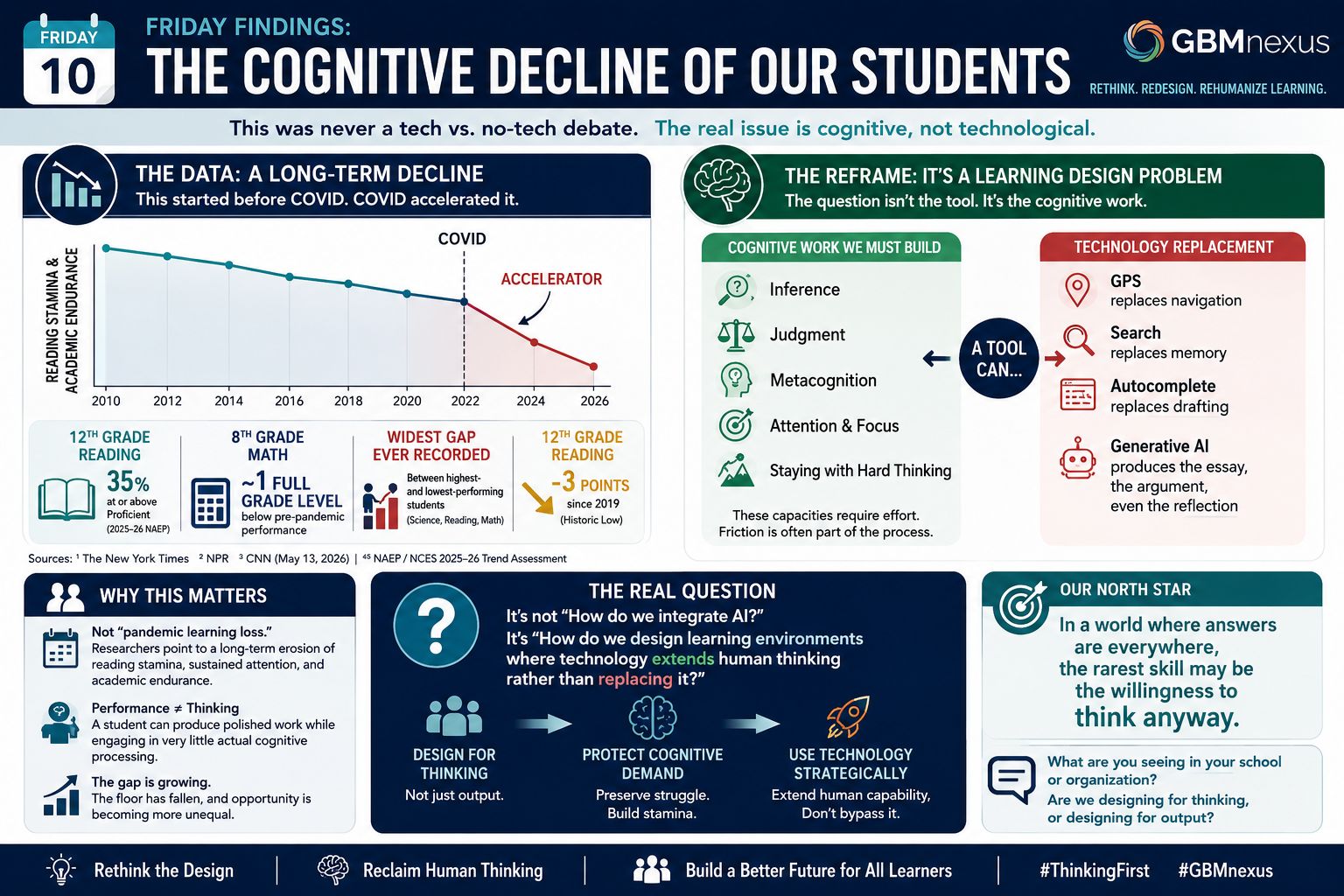
The Cognitive Decline of Our Students

Beyond Code: The Human Wisdom Students Need in the Age of AI

Coming across this interview with Jensen Huang recently, he spoke about intelligence in a way that feels especially relevant in this age of AI. 

The “smartest” person, as he suggested, is not simply the one who can code the fastest, programme the best, or master the most technical skills. It is also the person who understands people. Because in the age of AI, intelligence cannot be reduced to technical ability alone. 

A student may know how to use AI. They may know how to write a good prompt. They may even know how to code. 

But if they lack empathy, responsibility, critical thinking, moral judgement, and human awareness, then something essential is still missing. 

Technical skills matter. Of course they do. But they are not enough. We need to help students learn how to think before using AI. 

How to pause before accepting an answer. How to question outputs. How to understand context. How to recognise bias. How to make responsible decisions. How to care about the impact of what they create, submit, or share. 

Most of all, we need to help them remain human while working with increasingly powerful tools. Because the future will not only need people who know how to use AI. It will need people who know how to use AI with wisdom. 

And perhaps that is the real challenge before education now. Not just producing technically capable students, but nurturing young people who can think clearly, understand others deeply, and carry responsibility well.


When AI Cannot Replace the Human Touch: What Yuna’s Words Remind Us About HAIL

A recent Malay Mail article on Yuna’s achievement as the first Malaysian artist to surpass one billion Spotify streams carried something more meaningful than just a milestone.

Yuna becomes first Malaysian artist to hit one billion Spotify streams, says AI can’t replace human touch

It also captured her view that AI, however advanced, cannot replace the human touch in music.That stayed with me.Because it is easy, in this moment, to be impressed by what AI can produce.

A song.
A paragraph.
A lesson plan.
A voice.
An image.

Even something that looks and sounds almost human.But almost human is not the same as human.

Music reminds us of this. A song is not only melody, arrangement, or lyrics. It carries memory, struggle, timing, culture, silence, instinct, and sometimes the small imperfections that make it feel alive. The same is true in education.Learning is not only the finished answer.It is the thinking before the answer.

The hesitation.
The discussion.
The mistake.
The attempt to explain something in your own words.

The quiet moment when a student finally understands.These things matter, even if they are not always measurable.Yuna’s comment is a timely reminder that technology may support human creativity, but it should not flatten it. In the classroom, the same principle applies. AI can help. It can suggest, summarise, translate, organise, and offer possibilities. But it should not become the place where students surrender their own thinking too quickly.This is where frameworks such as HAIL become useful, not as a campaign against AI, but as a reminder of proportion.

Use the tool.
But do not lose the person.

For students, that means learning to pause before outsourcing a thought. For teachers, it means guiding young people to see AI as support, not as a substitute for effort, judgement, or voice.Perhaps the real challenge is not whether AI can create something impressive.It can.The deeper question is whether we are still helping students develop the human qualities that make their work meaningful in the first place.

Curiosity.
Discipline.
Original thought.
Responsibility.
Taste.
Care.

A point of view.

Yuna’s milestone is worth celebrating because it was not built by automation.
It was built through years of voice, craft, identity, and persistence.That is the part we should not forget.

In music, in learning, and in life, the human touch is not a decorative extra.
It is the thing that gives the work its soul.

The Human Side Of AI In The Classroom

and Why HAIL Matters A recent opinion piece in The Pioneer titled “The human side of AI in the classroom” raises a timely and important point: AI is no longer sitting at the edges of education. It is already shaping how students learn, how teachers respond, and how classrooms adapt. The article rightly recognises the […]

Think First, AI Second: Why the Future-Ready Learner Must Remain Human

THE QUESTION IS NO LONGER WHETHER STUDENTS WILL USE AI

AI is no longer waiting at the edge of education. It has already entered the classroom, the homework table, the search bar, the writing process, and the way many students now begin a task.

A student can ask AI to explain a concept, generate an essay outline, correct grammar, solve a problem, summarise a chapter, or produce an answer that looks complete within seconds. This is not a future concern. It is already part of the learning landscape.

So the real question is no longer whether students will use AI.

They will.

The more important question is whether they will be ready to use it with judgement.

That is where many education systems must pause. In the global push for AI in education, there is a strong temptation to move quickly. Platforms are introduced. Tools are demonstrated. Policies are drafted. Training programmes are announced. All of this has value, but it is not enough.

Because technical access without human formation can create a dangerous imbalance.

A recent reflection by Second Step rightly points to the importance of human skills in the age of AI, particularly skills such as empathy, communication, critical thinking, emotional regulation, collaboration, and responsible decision-making. It also makes a simple but important point: digital literacy cannot stand apart from the human skills that help students use technology well. 

This is deeply aligned with the purpose of the HAIL Framework.

HAIL does not begin with the machine. It begins with the learner.

DIGITAL LITERACY NEEDS A HUMAN FOUNDATION

For many years, digital literacy was understood as the ability to access, use, and navigate technology. That understanding was necessary, especially in communities where access to technology education has been uneven.

But in the age of AI, digital literacy must mature.

It is no longer enough for a student to know how to click, search, prompt, copy, paste, or submit. The deeper question is whether the student understands what they are doing, why they are doing it, and what responsibility they carry once AI has produced an answer for them.

AI can make learning faster. But faster is not always deeper.

AI can produce fluent text. But fluency is not the same as wisdom.

AI can detect patterns. But patterns are not the same as truth.

AI can assist students. But it must not replace the slow and necessary formation of thought.

This matters because learning is not merely the production of correct-looking answers. Learning involves effort. It involves uncertainty. It involves trying, failing, revising, discussing, questioning, and slowly building judgement. These are not inefficiencies to be removed. They are part of how young people become thoughtful.

If students begin using AI from the get-go, before they have developed the discipline to think for themselves, there is a risk that AI becomes more than a tool. It becomes the starting point of thought.

That is the point where education must be careful.

THE SKILLS THAT AI CANNOT CARRY FOR US.

There is a tendency to call empathy, patience, communication, collaboration, ethical judgement, and emotional regulation “soft skills”.

I have never found that phrase helpful.

There is nothing soft about a child learning to pause before reacting. There is nothing soft about a student learning to disagree respectfully. There is nothing soft about admitting uncertainty, asking better questions, or choosing not to use a convenient answer because something about it feels unfair, incomplete, or untrue.

In the age of AI, these are not extra skills.

They are survival skills.

A future-ready learner is not simply a student who can prompt well. A future-ready learner is a student who can think clearly, question carefully, care deeply, and use AI without surrendering their own judgement.

That is a much higher standard.

It means students must learn to ask:

Is this true?

Is this fair?

Who is affected?

What is missing?

What do I think first?

Am I ready to stand behind this answer?

These questions may look simple, but they are profoundly human. They require conscience. They require context. They require the ability to see beyond the output and consider the person, community, culture, or consequence behind it.

AI does not carry that responsibility for us.

We do.

WHY THIS MATTERS NOW.

The urgency is not because AI is evil. It is not.

The urgency is because AI is powerful, accessible, persuasive, and increasingly invisible in the way students learn.

A weak answer written by a student often reveals the student’s confusion. A polished answer generated by AI can hide it. That is one of the quiet risks. It can make unfinished thinking look complete.

For teachers, this changes the work of education. The challenge is no longer only to help students arrive at an answer. It is to help them understand how the answer was formed, whether it deserves trust, and whether they have done enough thinking before accepting it.

This is why teachers remain essential.

AI may support a classroom, but it cannot replace the teacher’s role as a values anchor. Teachers understand context. They notice hesitation. They hear the silence before a child speaks. They understand local realities, family pressures, cultural sensitivities, confidence, fear, and the fragile process through which young people learn to think.

A machine can generate a response.

A teacher helps form a person.

That distinction must not be lost.

HAIL: THINK FIRST, AI SECOND AS A TOOL.

The HAIL Framework was developed from this concern.

At its heart, HAIL is built on a simple principle: Think First, AI Second as a tool.

This is not a slogan. It is a safeguard.

It reminds students that AI should not be the first place they surrender their thinking. It should be a support after they have paused, considered, questioned, and formed an initial view of their own.

HAIL is human-centered AI learning. It does not reject technology. It restores proportion.

It says that before students use AI to write, they must first learn to think. It must never be used to do the thinking for a student.

Before they ask AI for an answer, they must first understand the question.

Before they accept an output, they must learn to verify it.

Before they submit AI-assisted work, they must understand that responsibility remains human.

This is especially important in education systems where AI adoption is being pushed quickly. If the focus is only on tools, platforms, and productivity, we may produce students who are technically fluent but intellectually dependent.

That would be a poor outcome.

The purpose of responsible AI education is not to make students faster at outsourcing thought. It is to help them become more capable of thinking with discipline, humility, and care.

A MORE HUMAN FUTURE FOR AI IN EDUCATION. 

The future of AI in education should not be built on fear. But neither should it be built on blind enthusiasm.

It must be built on responsibility.

If we want students to use AI well, we must protect the space where human judgement develops. That space includes struggle. It includes reflection. It includes discussion. It includes the teacher’s guidance. It includes moments when students are allowed to be unsure, to change their minds, and to learn that not every answer should be accepted simply because it appears confidently on a screen.

Human skills are not a sentimental add-on to AI literacy.

They are the foundation that makes AI literacy responsible.

The global push for AI in education gives us a rare opportunity. We can either rush into tool-first adoption and correct the damage later, or we can build human-first AI literacy from the beginning.

HAIL chooses the second path.

It asks schools, teachers, parents, and policymakers to remember that the learner matters more than the tool. It asks us to prepare students not only to use AI, but to remain thoughtful while using it. It asks us to keep conscience, context, and accountability at the centre of learning.

The task before us is not simply to make students ready for AI. It is to make sure that as AI becomes more powerful, our students become more thoughtful, more responsible, and more fully human in the way they learn, decide, and live.

This blog entry is informed by this article written on the 29th of April 2026:


https://www.secondstep.org/resources/blog/future-ready-learners-why-human-skills-matter-in-the-age-of-ai
” What is the meaning of AI if humanity is eroded? ” Malaysia’s PM Anwar tells youths at Pahang gathering

KUANTAN, April 3, 2026 — Prime Minister Datuk Seri Anwar Ibrahim stressed that holistic education, combined with strong moral grounding and human values, is a crucial foundation to shaping the country’s future generation. He said that in an increasingly challenging world and driven by technological advancements, such as artificial intelligence (AI), youths must not only […]