The AI Risk of losing the skills you’ve mastered over the years
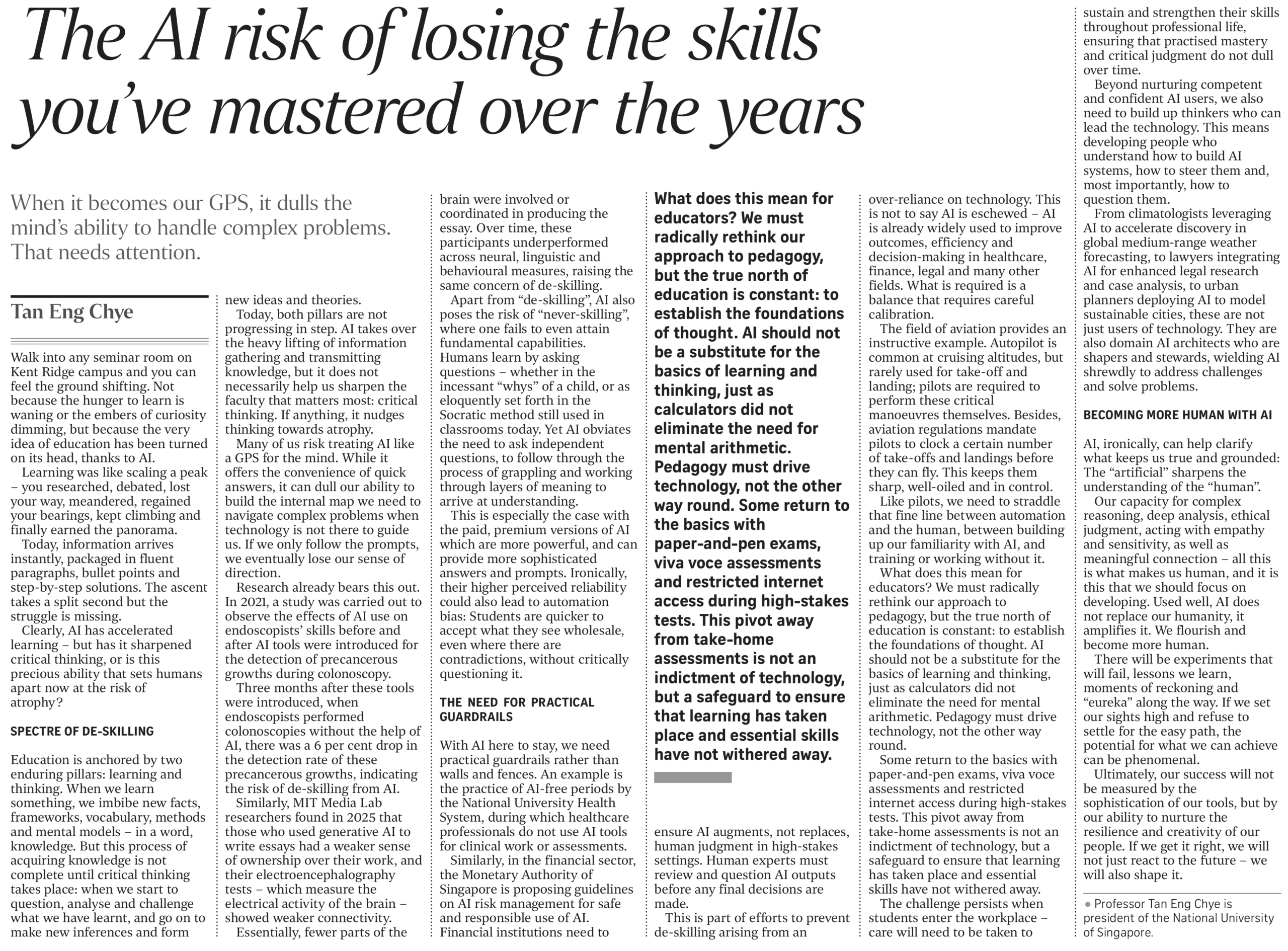
AI is changing how we learn, work, write, think, and make decisions.That is not necessarily a bad thing. But Professor Tan Eng Chye’s recent opinion piece in The Straits Times raises a concern we should take seriously: when AI becomes too convenient, we may slowly lose the very skills we once worked hard to master.
He describes AI as a kind of “GPS for the mind”, useful for quick direction, but dangerous if it weakens our ability to build our own internal map.
This matters deeply in education.Learning is not just about reaching the answer. It is about the struggle that forms understanding. The questioning. The confusion. The revision. The slow process of connecting ideas until something becomes truly our own.
AI can help students produce polished work. But polished work is not always proof of deep thinking.This is the danger of the illusion of competence.
A student may appear capable because the output looks good. But beneath the surface, have they learnt to reason, question, verify, explain, and make responsible judgements?The article also warns about “de-skilling” and “never-skilling”.
De-skilling is when we lose abilities we once had. Never-skilling is when young learners never develop those abilities properly in the first place because AI answers too quickly.
For Generation Alpha, this is especially important.They will not lack access to tools. They will not lack speed. They will not lack information.What they need is the wisdom to use these tools without surrendering their own thinking.
This does not mean we should reject AI. That would be too simple, and unrealistic. AI is here, and it can support learning powerfully when used well.
But the order matters.
Students must still learn to think before they outsource. They must learn to ask before they accept. They must learn to struggle before they generate.
AI should support the mind, not replace its formation.
That is the deeper responsibility before us.
Not to raise students who can simply produce better answers.
But to form young people who can think with clarity, act with responsibility, and use technology with wisdom.
Human first.
AI as a tool, second.
Leave a Reply
Want to join the discussion?Feel free to contribute!