
AI Is Changing How We Think. What Is It Changing In Us?
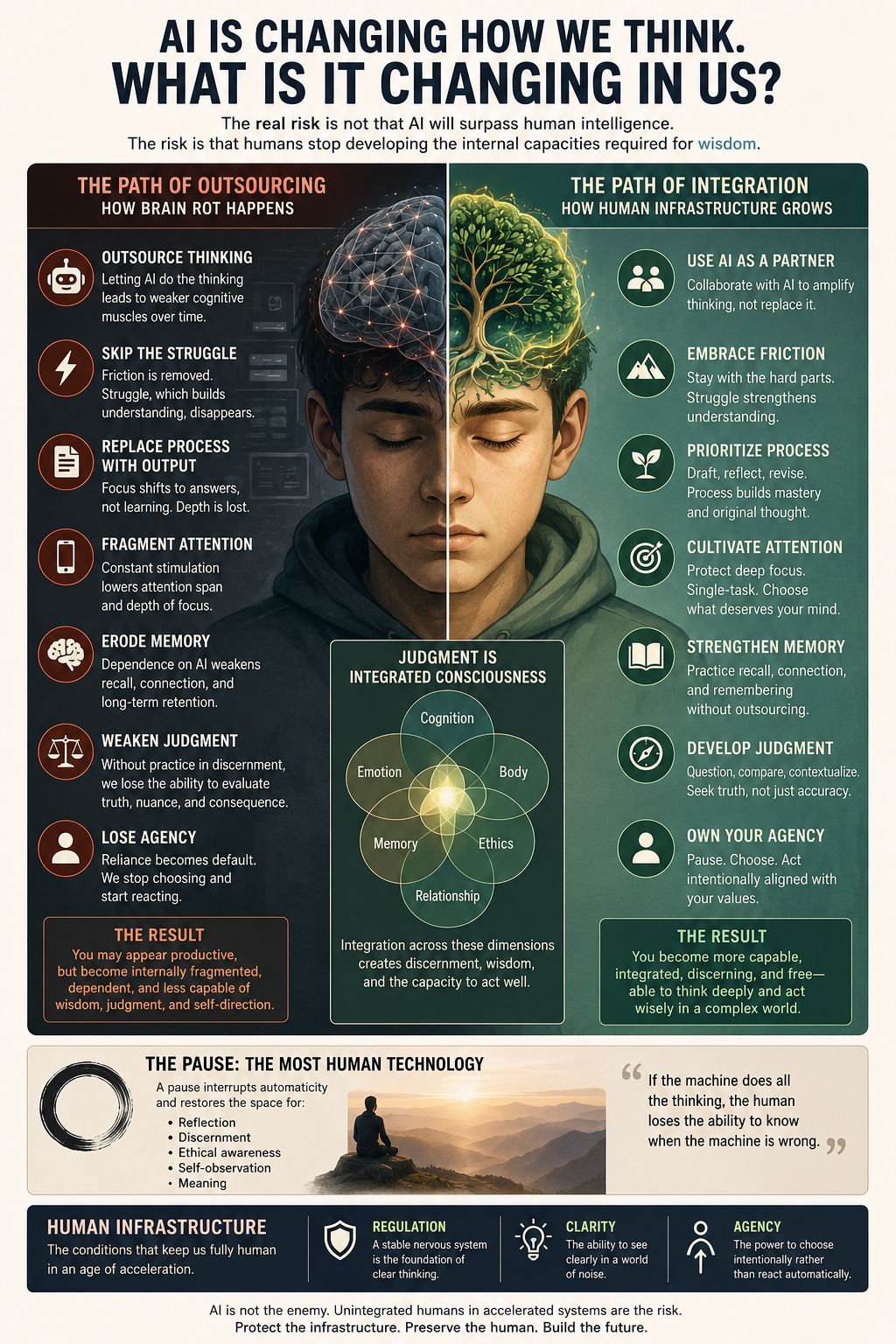
Inspired by Orli Shull’s powerful reflection on “human infrastructure” in the age of AI.
AI is not the enemy.
But there is a risk we should be honest enough to name.
If we allow AI to do too much of our thinking too early, we may slowly weaken the very capacities that make us human: attention, memory, judgement, discernment, agency, and wisdom.
The danger is subtle.
The work may look better.
The answers may sound sharper.
The output may appear more polished.
But beneath the surface, are we still thinking deeply?
Are we still struggling through the difficult parts?
Are we still learning to question, compare, remember, reflect, and decide?
This matters deeply for education, especially for Generation Alpha.
They will grow up surrounded by instant intelligence. Answers will be available before questions are fully formed. Explanations will arrive before confusion has had time to do its work.
But confusion is not always a problem to remove.
Sometimes, it is the beginning of understanding.
The struggle matters.
The pause matters.
The first attempt matters.
The mistake matters.
The moment a student says, “I am not sure yet,” matters.
These are not delays in learning. They are part of how the mind is formed.
AI can be a powerful partner. It can support thinking, widen perspectives, help refine ideas, and make learning more accessible.
But it should not replace the formation of the learner.
If the machine does all the thinking, the human may still produce an answer. But will they know when the answer is wrong?
Will they know what is missing?
Will they know how to act with wisdom?
This is why we need to protect our human infrastructure.
Attention.
Memory.
Ethics.
Reflection.
Judgement.
Empathy.
Agency.
These are not soft skills.
They are survival skills for an AI-shaped world.
The future will not only depend on how intelligent AI becomes.
It will depend on how deeply human we remain while using it.
Leave a Reply
Want to join the discussion?Feel free to contribute!