Half Sized Blog Element (Single Author Style)
Half Sized Blog Element (Multi Author Style)

Better Output Is Not Always Better Learning
Dr. Genevieve Bosma Martínez recently shared an important reflection on AI in education, and it touches on a tension that many of us need to sit with more honestly.
AI can help students produce better work.
That much is clear.
A piece of writing may become more polished. An answer may become more complete. A project may look more refined. In many cases, AI can help students move faster, organise their thoughts better, and improve the quality of what they submit.
But this raises a deeper question.
Does better output always mean deeper learning?
Not necessarily.
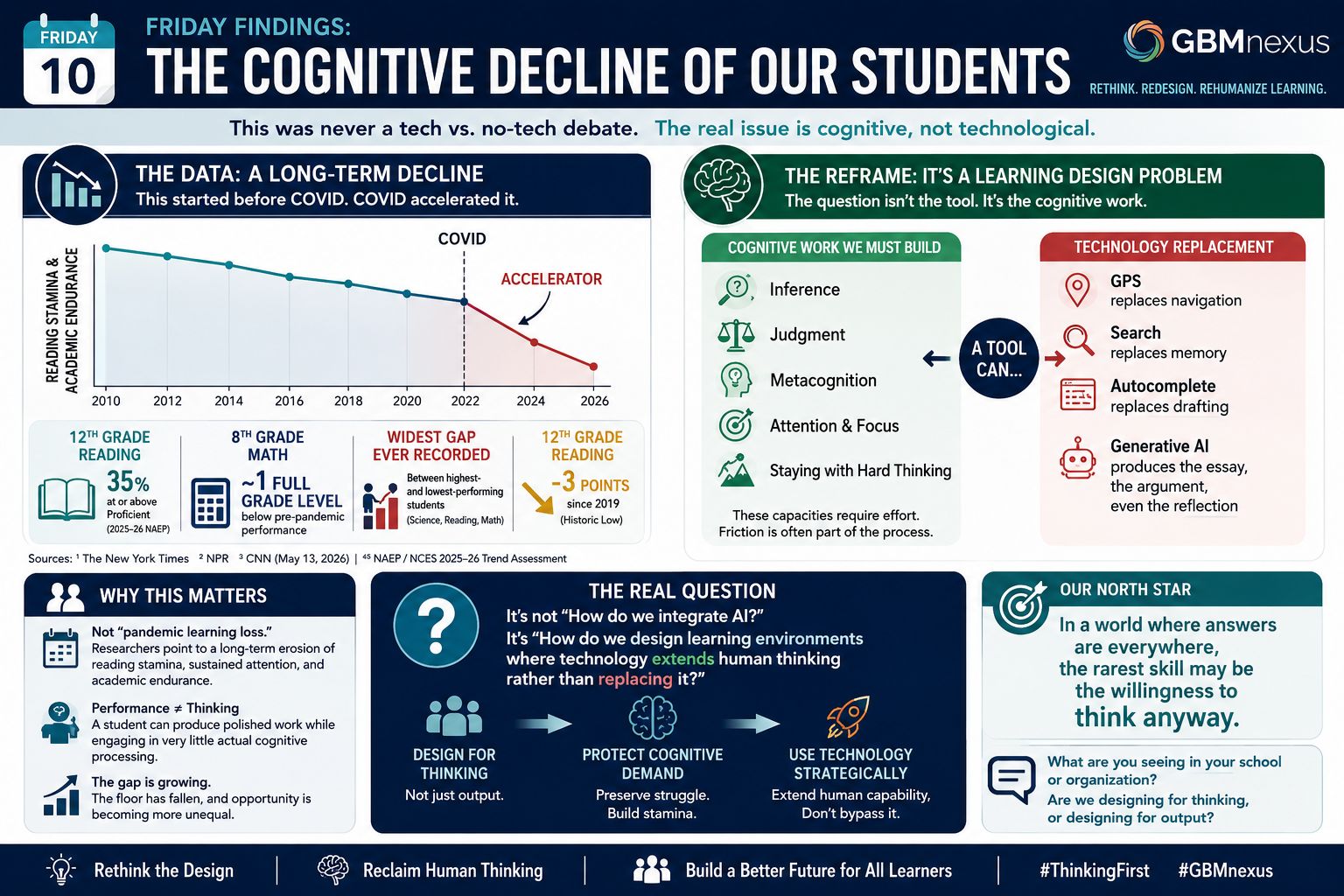
This is where the conversation becomes important.In education, we cannot only look at the final answer. We have to look at what happens inside the learner before that answer appears. Did the student understand the problem? Did they wrestle with the question? Did they compare ideas, test assumptions, make mistakes, and try again? Did they learn how to explain their reasoning?
Or did AI simply help them arrive at a better-looking answer before the learning had time to take root?
This is not an argument against AI.
AI has a place in education. It can support teachers. It can help students refine their ideas. It can open access to explanations, examples, feedback, and creative possibilities that were not available in the same way before.
But AI must enter the learning process with care.The concern is not that students are using AI.
The concern is that they may begin to depend on AI before they have developed the human capacities that education is meant to strengthen.
Critical thinking.
Problem solving.
Judgement.
Reflection.
Responsibility.
The ability to sit with uncertainty.
The confidence to think before asking a machine to think for them.These are not small things. They are the foundations of learning itself.If students use AI too early in the process, there is a risk that the visible work improves while the invisible learning weakens. The assignment may look better, but the student may not become more capable.
The answer may be correct, but the reasoning may remain underdeveloped.
That should concern us.
Because the purpose of education is not simply to produce neat answers. It is to form thoughtful human beings.
This is why human-centred AI learning matters.
It reminds us that technology should support the learner, not replace the learner’s thinking. AI should help students extend their understanding, not bypass the struggle that helps understanding grow.
There is a kind of learning that only happens through effort.
Through confusion.
Through discussion.
Through trying to explain something in your own words and realising you do not fully understand it yet.
Through making a mistake and learning why it was wrong.
Through listening to another person’s point of view.
Through slowly building the confidence to say, “This is what I think, and this is why.”
AI can assist this process.
But it should not remove it.
The future of education cannot be measured only by speed, efficiency, or polished outputs. If we are not careful, we may teach students how to generate impressive work without helping them become independent thinkers.
And that would be a poor bargain.In an age where AI can generate almost anything, the role of education becomes even more human, not less.
We must teach students how to question.
How to judge.
How to care.
How to take responsibility for what they create.How to use powerful tools without surrendering their own agency.
AI should be a support tool.
Not the starting point.
Not the substitute.
Not the authority.
The human mind must remain at the centre of learning.
That is the work ahead of us.
Original posting:
The Cognitive Decline of Our Students
Better Output Is Not Always Better Learning
/0 Comments/in Uncategorized /by scottjwong@gmail.comDr. Genevieve Bosma Martínez recently shared an important reflection on AI in education, and it touches on a tension that many of us need to sit with more honestly.
AI can help students produce better work.
That much is clear.
A piece of writing may become more polished. An answer may become more complete. A project may look more refined. In many cases, AI can help students move faster, organise their thoughts better, and improve the quality of what they submit.
But this raises a deeper question.
Does better output always mean deeper learning?
Not necessarily.
This is where the conversation becomes important.In education, we cannot only look at the final answer. We have to look at what happens inside the learner before that answer appears. Did the student understand the problem? Did they wrestle with the question? Did they compare ideas, test assumptions, make mistakes, and try again? Did they learn how to explain their reasoning?
Or did AI simply help them arrive at a better-looking answer before the learning had time to take root?
This is not an argument against AI.
AI has a place in education. It can support teachers. It can help students refine their ideas. It can open access to explanations, examples, feedback, and creative possibilities that were not available in the same way before.
But AI must enter the learning process with care.The concern is not that students are using AI.
The concern is that they may begin to depend on AI before they have developed the human capacities that education is meant to strengthen.
Critical thinking.
Problem solving.
Judgement.
Reflection.
Responsibility.
The ability to sit with uncertainty.
The confidence to think before asking a machine to think for them.These are not small things. They are the foundations of learning itself.If students use AI too early in the process, there is a risk that the visible work improves while the invisible learning weakens. The assignment may look better, but the student may not become more capable.
The answer may be correct, but the reasoning may remain underdeveloped.
That should concern us.
Because the purpose of education is not simply to produce neat answers. It is to form thoughtful human beings.
This is why human-centred AI learning matters.
It reminds us that technology should support the learner, not replace the learner’s thinking. AI should help students extend their understanding, not bypass the struggle that helps understanding grow.
There is a kind of learning that only happens through effort.
Through confusion.
Through discussion.
Through trying to explain something in your own words and realising you do not fully understand it yet.
Through making a mistake and learning why it was wrong.
Through listening to another person’s point of view.
Through slowly building the confidence to say, “This is what I think, and this is why.”
AI can assist this process.
But it should not remove it.
The future of education cannot be measured only by speed, efficiency, or polished outputs. If we are not careful, we may teach students how to generate impressive work without helping them become independent thinkers.
And that would be a poor bargain.In an age where AI can generate almost anything, the role of education becomes even more human, not less.
We must teach students how to question.
How to judge.
How to care.
How to take responsibility for what they create.How to use powerful tools without surrendering their own agency.
AI should be a support tool.
Not the starting point.
Not the substitute.
Not the authority.
The human mind must remain at the centre of learning.
That is the work ahead of us.
Original posting:
The Cognitive Decline of Our Students
Beyond Code: The Human Wisdom Students Need in the Age of AI
/0 Comments/in Uncategorized /by scottjwong@gmail.comComing across this interview with Jensen Huang recently, he spoke about intelligence in a way that feels especially relevant in this age of AI.
The “smartest” person, as he suggested, is not simply the one who can code the fastest, programme the best, or master the most technical skills. It is also the person who understands people. Because in the age of AI, intelligence cannot be reduced to technical ability alone.
A student may know how to use AI. They may know how to write a good prompt. They may even know how to code.
But if they lack empathy, responsibility, critical thinking, moral judgement, and human awareness, then something essential is still missing.
Technical skills matter. Of course they do. But they are not enough. We need to help students learn how to think before using AI.
How to pause before accepting an answer. How to question outputs. How to understand context. How to recognise bias. How to make responsible decisions. How to care about the impact of what they create, submit, or share.
Most of all, we need to help them remain human while working with increasingly powerful tools. Because the future will not only need people who know how to use AI. It will need people who know how to use AI with wisdom.
And perhaps that is the real challenge before education now. Not just producing technically capable students, but nurturing young people who can think clearly, understand others deeply, and carry responsibility well.